Understanding Paystack’s developers, to shape the developer experience strategy

Company

Paystack
with the Developer Relations team

Role

UX researcher
Interview lead

Users

Developers & hobbyists
CTOs, founders & PMs
Finance teams

Methods

In-depth interviews
Developer survey
Synthesis workshop
Personas

FintechDeveloper experienceResearch

The goal

Make Paystack the gold standard for developer experience in Africa, starting with who its developers really are.

The Developer Relations team wanted to improve every developer-facing touchpoint and cut the time it takes to make a first API call. They asked the design team to lay the research foundation: who uses Paystack’s developer products, where to reach them, what content they respond to, and what tools they use.
Objective 01

Define Paystack’s developer personas, covering developers and the people around them who shape the decision.

Objective 02

Inform a redesign of the API docs’ information architecture.

Hypothesis

Knowing our developers will let us build resources that save them time

Faster evaluation

Less time spent deciding whether Paystack is the right fit.

Faster integration

Less time spent getting from sign-up to a working integration.

Fewer support requests

Fewer integration questions reaching technical support.


01 · Research

Four groups, one conversation guide

Process

From objective to insights, one step at a time

We framed the objective, reviewed what was already known, set research questions, and described the audience before choosing methods. I led the interviews alongside the DevRel team, focusing on how developers choose a payments partner and how they use Paystack today.

Who we spoke to

Not just developers, but everyone who shapes the integration

We recruited from key accounts, merchants who build on Paystack’s code solutions, and teams that use the API docs heavily.

Developers

High proficiency

The primary users, building scalable products who need to understand exactly how the APIs work.

Hobbyists

High proficiency

Developers building personal and open-source projects, often in languages Paystack doesn’t officially support.

Decision makers

Tech adjacent

CTOs, founders and PMs who weigh cost, support and reputation as much as the code.

Finance teams

Basic proficiency

Treasury and accounting teams who need to know Paystack supports their everyday work.

15one-on-one interviews about content, engineering decisions and communities
194survey responses from developers in Nigeria, Kenya, Ghana and South Africa
54%of respondents weren’t in any developer community, but wanted to be

Discussion guide

What we wanted to understand

Choosing and using Paystack

  • How developers find and decide between payment providers
  • Which Paystack resources they know, use and skip, and why
  • What gets in the way when integrating, and how they escalate it

The wider developer world

  • The communities they belong to, and the content formats they prefer
  • How their engineering teams make tooling decisions
  • What they struggle with as developers based in Africa

02 · Insights

What developers told us

Choosing a provider

The docs are the first product developers try

Evaluation starts with the documentation. If it’s easy to understand and easy to test without writing code, the decision is half made. Support, cost and how quickly a team can learn the product decide the rest, and founders lean heavily on each other’s experiences.

Part of it is vibes. You go to their docs and it’s easy to understand, so you like it already.

I can avoid spending valuable time integrating with a partner just from hearing feedback from founders who are more experienced.

If Paystack had put a big “beta” sign on it, it would have helped me manage my expectations.

Using the docs

Payments are well covered. What happens after a payment isn’t.

Post-payment gaps

Disputes, chargebacks and refunds lacked clear how-to guides. One CTO said they’d read 60 pages on chargebacks, because they cost money.

Hidden tools

Useful tools like the CLI sat out of sight, and features like card tokenisation weren’t stated clearly. Search could do more.

Beyond JavaScript

Developers using other languages wanted friendlier examples, typed response fields, and a shortcut to the most used endpoints.

Content and community

Different developers, different formats

Content

  • Beginners prefer video, experienced developers prefer text, and busy founders reach for podcasts
  • Appetite for deeper technical content, like how card processing really works and how companies scale

Community

  • Smaller, niche events over large sponsorships, and every few months rather than monthly
  • Informal founder networks are where reputations are made or lost

Great developer experience starts long before the first API call.

The takeaway

03 · Personas

Three developers, at three stages of a career

Synthesis

From interviews to archetypes, checked against the survey

We built three personas from the interviews and validated them with the survey data. Nearly half of respondents (46%) had up to three years’ experience, so the junior developer needed as much attention as the CTO. With the DevRel team, we then mapped where DevRel was winning, where it wasn’t, and the opportunities in between.

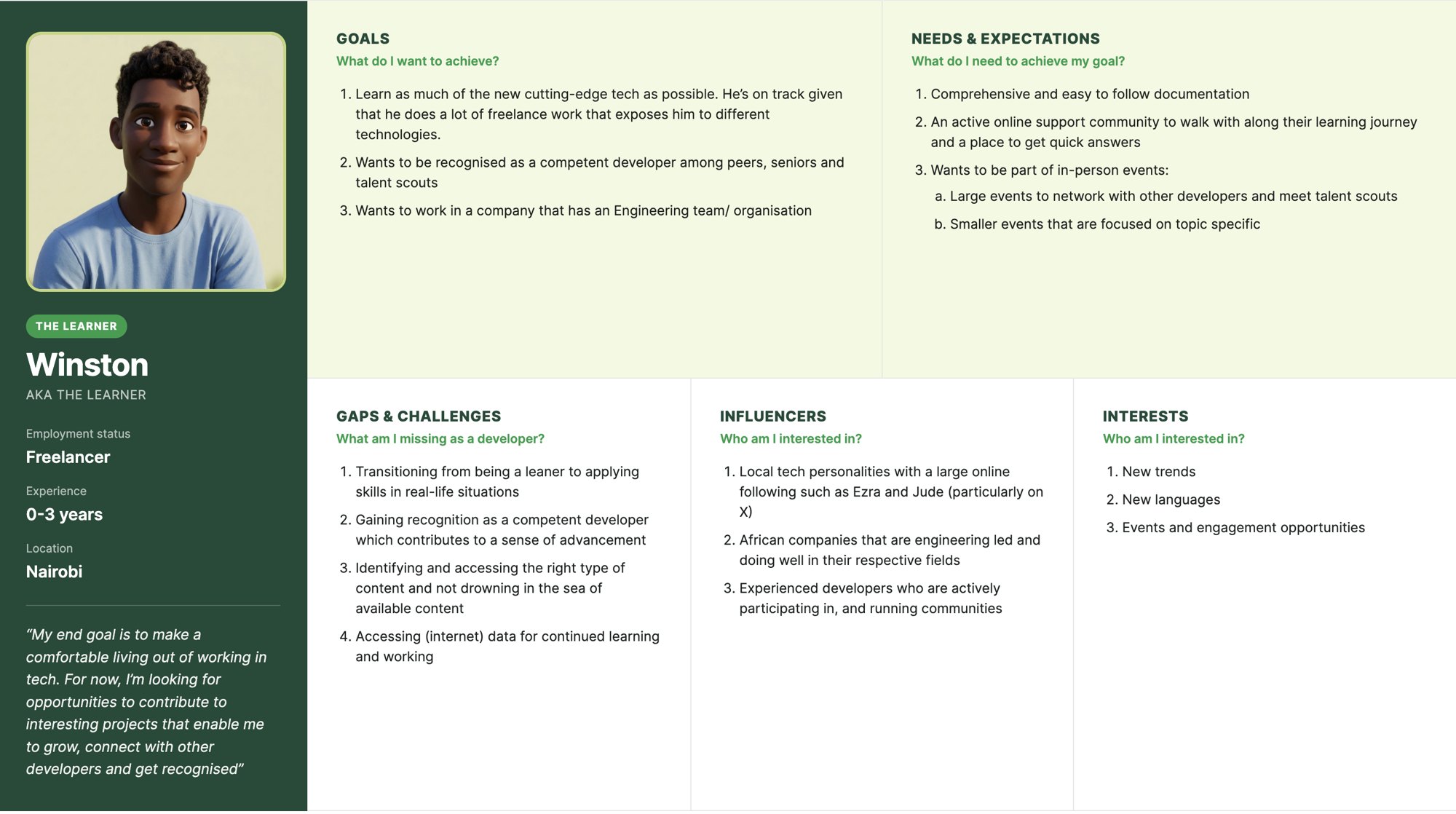
Persona 01 · The Learner

Winston

Freelancer · 0–3 years · Nairobi

“My end goal is to make a comfortable living out of working in tech. For now, I’m looking for opportunities to contribute to interesting projects that enable me to grow, connect with other developers and get recognised.”

What they need

  • Comprehensive, easy-to-follow documentation
  • An active online community for quick answers
  • Large events to network, and smaller topic-focused ones

Gaps and challenges

  • Moving from learning to applying skills in real projects
  • Finding the right content without drowning in it
  • Affording internet data to keep learning and working
Full persona for Winston: goals, needs, challenges, influencers, interests
Select to open the full persona.

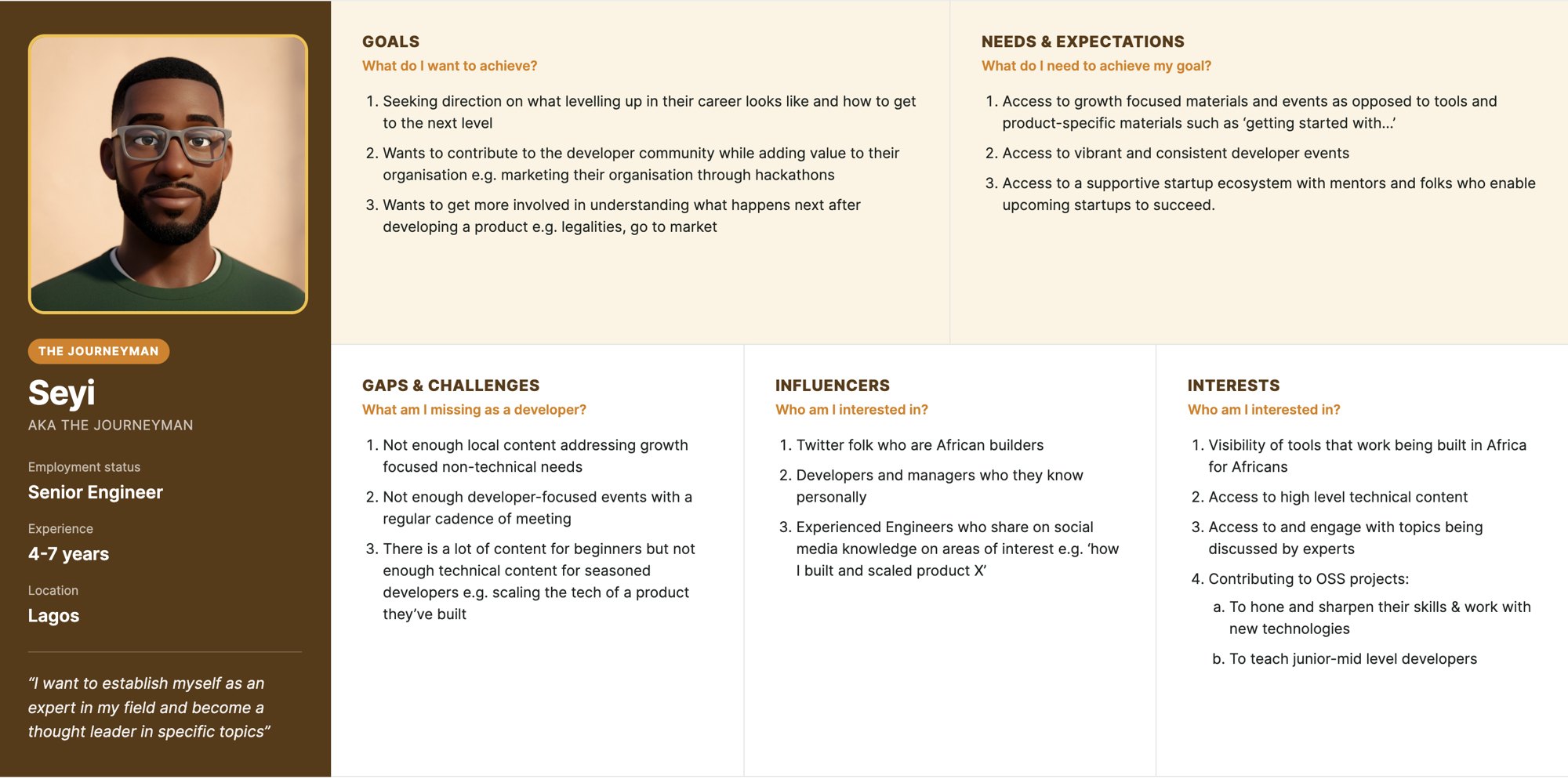
Persona 02 · The Journeyman

Seyi

Senior engineer · 4–7 years · Lagos

“I want to establish myself as an expert in my field and become a thought leader in specific topics.”

What they need

  • Growth-focused materials and events, beyond “getting started”
  • Vibrant, consistent developer events
  • A supportive startup ecosystem with mentors

Gaps and challenges

  • Little local content on growth beyond the technical
  • Too few developer events with a regular cadence
  • Plenty for beginners, not enough for seasoned developers
Full persona for Seyi: goals, needs, challenges, influencers, interests
Select to open the full persona.

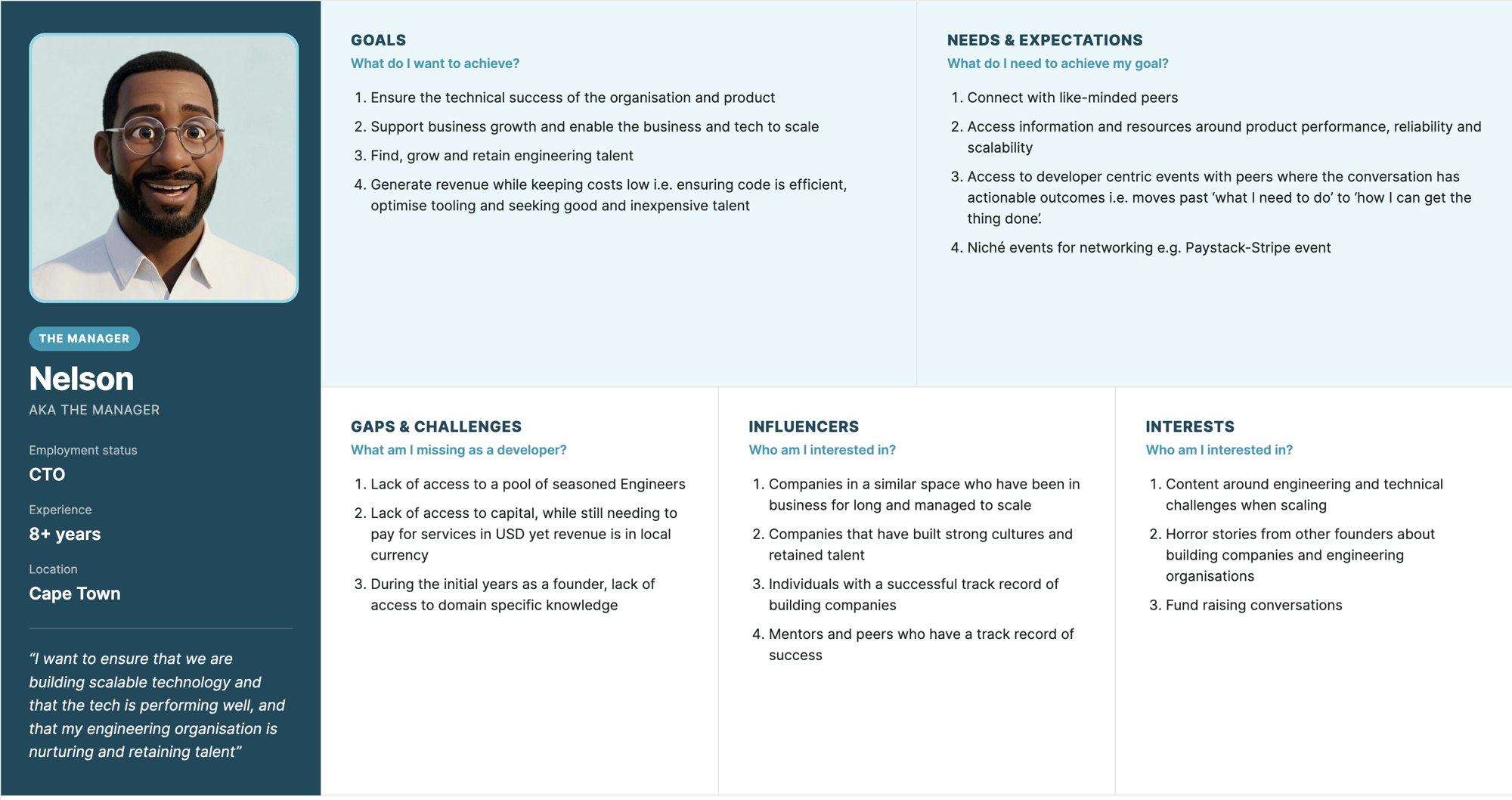
Persona 03 · The Manager

Nelson

CTO · 8+ years · Cape Town

“I want to ensure that we are building scalable technology and that the tech is performing well, and that my engineering organisation is nurturing and retaining talent.”

What they need

  • Peers facing the same problems
  • Resources on performance, reliability and scale
  • Niche events with actionable outcomes

Gaps and challenges

  • Few seasoned engineers to hire
  • Paying for services in USD while earning in local currency
  • Little access to domain knowledge in the early years
Full persona for Nelson: goals, needs, challenges, influencers, interests
Select to open the full persona.

04 · Opportunities

Where DevRel could act next

Docs

  • Pair reference docs with conceptual guides that go deeper
  • Add guides for post-payment operations like disputes and chargebacks
  • Make tools like the CLI easy to find

Content

  • Frame webinars around real software and business problems, solved with Paystack
  • Help developers decide which tools to use
  • Aim video tutorials at junior developers

Community

  • Host smaller, niche events, including in markets like Cape Town
  • Run sessions on scaling and growing a company

Trust

  • Label early products clearly, so developers can set expectations
  • Close the gap between support and the technical problem

05 · Outcome

Personas that now guide DevRel’s work

What changed

DevRel now plans content and events around the three personas, and used the findings to fix gaps in the docs and tools.

Docs and tools

Updated Transfers and Bulk Charge docs, a new Developer Tools section, common API errors with fixes, refreshed Node.js and Python libraries, and new Android and iOS SDKs.

Community

Meetups in Accra, Lagos and Nairobi, and sponsorship of DevConf ZA and the GirlCode ZA hackathon.

Persona-led events

A CTO roundtable in Lagos with AWS, designed for the Manager, on scaling infrastructure while keeping costs down.

Read Paystack’s write-up


Next project

Improving the experience of handling settlement issues on Watchtower

Read next case study